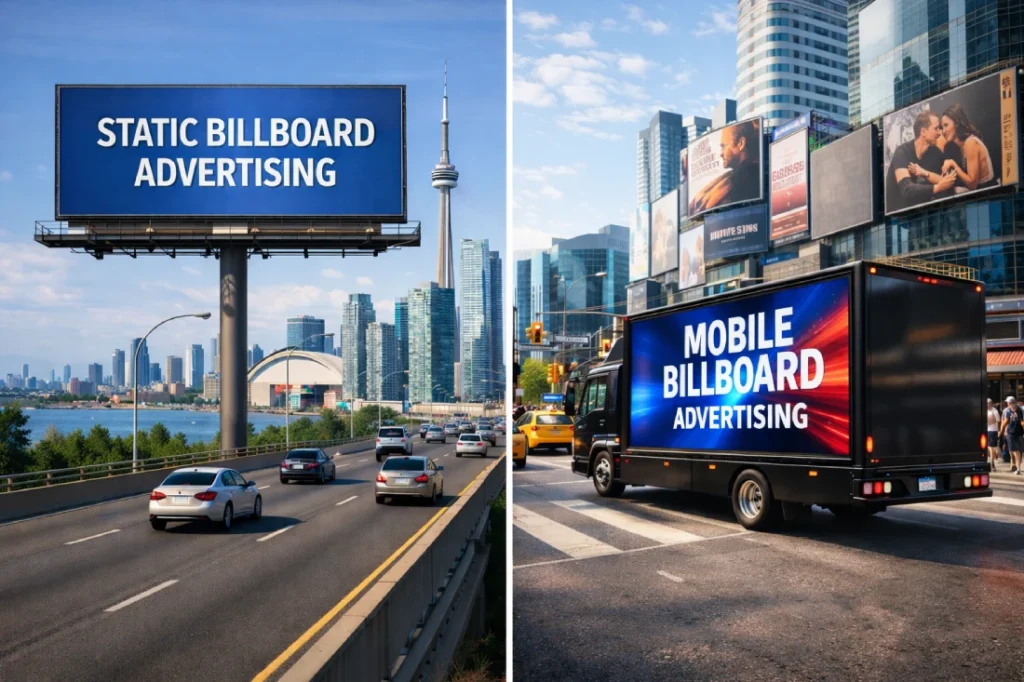
Saturation in advertising often challenges brand prominence, particularly in the congested Greater Toronto Area. Amidst this crowded landscape, OOH advertising has surged as a powerful medium for broad awareness, accounting for 80% weekly reach. This format commands a physical presence, offering brands tangible exposure that cuts through the noise. Companies seeking genuine interest are increasingly relying on outdoor formats to connect with audiences in naturally receptive environments.
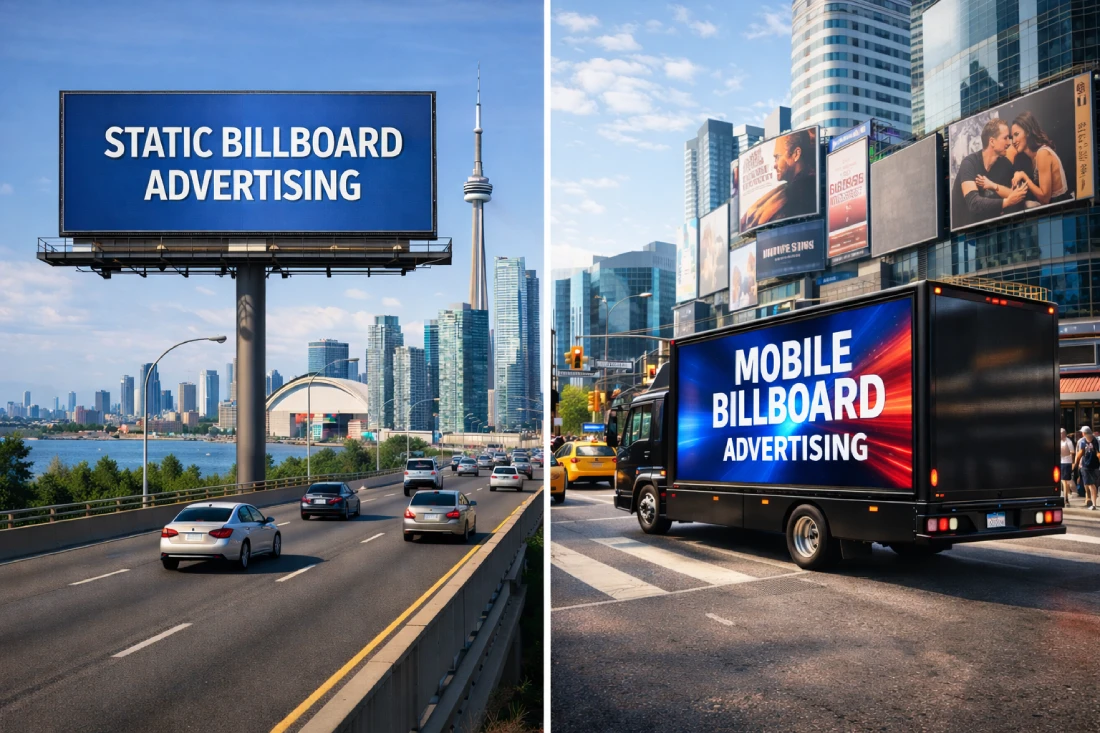
For businesses weighing their OOH options in the GTA, the choice often comes down to two distinct approaches: stationary large-format billboards secured in top-tier locations, or mobile billboard trucks that bring the message directly to audiences across the region. This guide breaks down how each format performs, where they excel, and which delivers stronger ROI for different campaign objectives in the GTA market.
What Is Static Billboard Advertising?
Static Billboard advertising refers to the stationary positioning of outdoor displays highlighting a creative message focused on capturing maximum attention. These large-format advertisements are strategically placed, coordinating with major intersections, highways, and urban landmarks. These billboards continue their consistent positioning for weeks and even months, offering continuous exposure to regular commuters and pedestrians.
In the Greater Toronto Area, such locations can be pinned along the Gardiner Expressway around Yonge-Dundas Square and the Don Valley Parkway (DVP). These areas draw the largest crowds, catering to heavy traffic. That benefits brands with captive audiences during rush hours.
The consistent delivery of repeated messages contributes to a strong recall over time. Dwelling for longer periods in congested zones helps with enhanced credibility. However, these static formats hold noticeable limitations. The fixed audience pool often leads to ad fatigue. Given the amount of investment in high-traffic locations, creatives cannot be changed quickly.
What Is Mobile Billboard Advertising in the GTA?
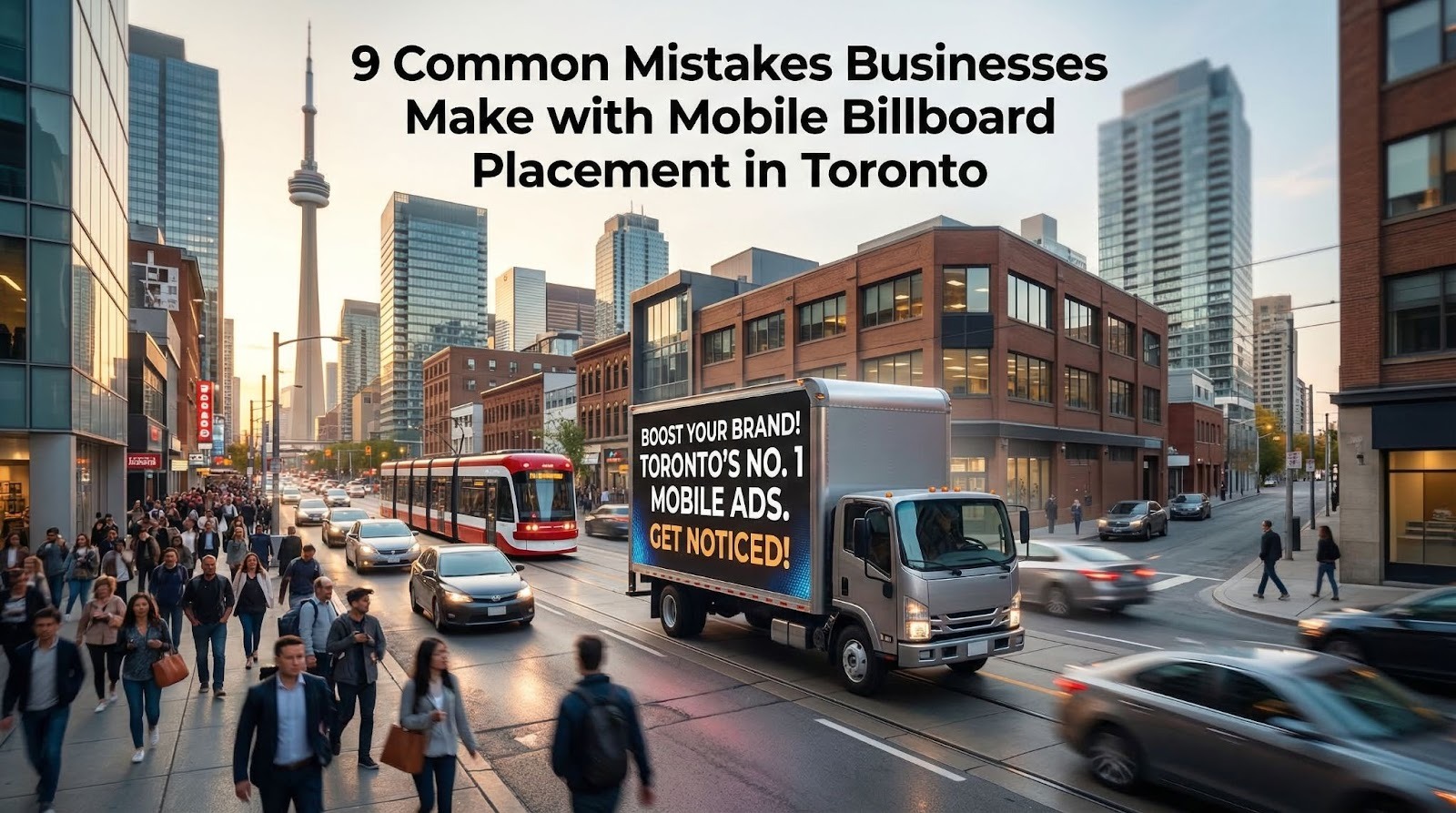
In a high-density, high-movement region like the Greater Toronto Area (GTA), capturing attention requires more than just a stationary sign; it demands strategic, mobile visibility. Mobile billboard advertising serves as a powerful tool to cut through the noise of a bustling metropolis, positioning brands directly in the line of sight of active consumers. Rather than waiting for audiences to pass a fixed point, this format actively intercepts them—turning traffic and busy districts into opportunities for engagement.
In a high-traffic metropolitan area like the Greater Toronto Area (GTA), capturing acute attention demands strategic visibility. Mobile billboard advertising empowers you in positioning brands directly in the line of sight. Instead of waiting for visibility at a single spot, this method takes the message to the audience, meeting audiences where their attention naturally shifts.
At its core, mobile billboard advertising can be understood in the form of Out-of-Home (OOH) marketing, where a branded display is emphasized via printed or digital tour. Brands take this opportunity to the most by selecting custom routes that enhance the visibility of campaigns among a broad audience on the move. Providers like Media Trucks strategize touring through geo-targeted areas, drawing viewer engagement across Toronto’s diverse routes. This mobility targets optimal times to deliver brand messaging at moments of peak audience presence.
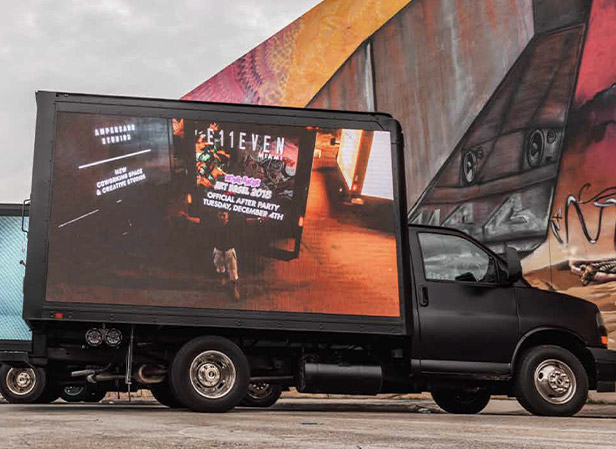
This marketing format leverages a dedicated truck for its purpose that serves as a meaningful medium for prompting audience awareness. This allows brands to have organic exposure without burdening audiences with repetitive placements. Most importantly, this advertising format allows for tailoring creatives to complement ongoing promotions or upcoming launches. This encourages localized engagement while expanding reach across the city.
Head-to-Head Comparison: Key Factors
Reach and Flexibility:
Comparing the potential between mobile and static billboard advertising in the GTA can be weighed in terms of reach and flexibility. As discussed earlier, mobile billboards can help brands gain recognition by travelling multiple high-traffic zones in a day. Whereas static billboards are tied to one physical location that limits visibility to a specific corridor.
Cost Efficiency:
Mobile billboard campaigns do not carry the heavy real-estate leasing fees associated with the premium highway or downtown placements. This often leads to a lower cost-per-thousand impression. Advertising through static boards involves higher upfront costs, catering to permits and long-term contracts.
Targeting Capability:
Mobile advertisement trucks offer exceptional advantages through geo-targeting precision. This enables brands to take custom routes by specific neighbourhoods, highlighting brand presence in rush hours and positioning trucks where the target demographics gather. This gives rise to recall rates often exceeding the mid-90% range. Static billboards do not provide any such flexibility. Once installed, they reach trespassing audiences only, without offering a definitive choice of reaching a target audience that matches your customer profile.
Recall and engagement:
Studies show higher engagement rates through advertisements on mobile billboards. Moving displays have proven to capture more visual presence. Industry insights reported 15 times higher engagement levels compared to stationary ads. This counts for viewer recall rates surpassing 96%. The novelty of a moving advertisement with eye-level positioning contributes to the ability to divert attention in multiple locations.
Campaign Duration
Static billboards showcase better potential for long-term brand campaigns. Here, consistent messaging is favoured over months of reinforcement for brand recognition. Mobile billboards work better for product launches, offering limited-time promotions or for short-burst campaigns. This kind of marketing requires focusing on high-intensity reach within weeks.
Creative Flexibility
Digital mobile billboards offer the flexibility to change creatives within hours. As a result, brands can quickly update messages based on current trends, flash sales, sports scores, or A/B testing insights. In contrast, static billboard campaigns require physical reprinting and installation crews. Because of this, brands must deal with longer timelines, higher costs, and limited creative flexibility.
When to Choose Static Billboards
Static billboards work best for brands that want consistent, long-term visibility. For example, they dominate highways and premium locations, ensuring 24/7 exposure. Moreover, they help build strong brand recall over time, especially along commuter corridors where repetition strengthens memory.
In addition, static placements support directional awareness and establish credibility in landmark locations. Therefore, they remain ideal for businesses focused on long-term branding rather than quick campaign shifts.
When to Choose Mobile Billboards
On the other hand, mobile billboards focus on flexibility and targeted reach. Because they move across key locations, brands can reach audiences in commercial hotspots, events, and high-traffic zones.
For instance, businesses can use mobile trucks for product launches, promotions, or short-term campaigns. As a result, they generate faster engagement and measurable ROI compared to fixed placements.
Why a Hybrid Strategy Works Best
In many cases, brands combine both formats to maximize results. Specifically, they use static billboards to maintain a strong, consistent presence. At the same time, mobile trucks expand their reach by targeting multiple locations.
Consequently, this hybrid strategy delivers both stability and flexibility. While static billboards reinforce brand memory, mobile billboards drive immediate visibility and engagement.
Why GTA Businesses Prefer Mobile Billboard Trucks
Mobile billboards perform exceptionally well in areas with heavy commuter traffic. For example, trucks can circulate messages across busy streets, neighborhoods, and commercial zones.
Additionally, LED screens and wrapped panels allow brands to adjust creatives based on audience movement. Because of this, businesses gain better control over where and when their message appears.
Furthermore, mobile formats offer precise targeting compared to fixed billboards. As a result, brands achieve stronger engagement and improved campaign performance.
FAQs
1. Which format is more cost-efficient in Toronto?
Mobile billboard campaigns usually offer lower CPM because they eliminate high real-estate costs. In contrast, static billboards require premium location fees and long-term contracts. Therefore, mobile trucks provide a more flexible budget option.
2. Which format delivers better engagement?
Mobile billboards capture attention quickly due to movement and placement. In fact, they often generate significantly higher engagement rates. Meanwhile, static billboards rely on repeated exposure over time.
3. Can I target specific neighbourhoods?
Static billboards stay fixed in one location. As a result, they reach only passing traffic. However, mobile billboards allow route-based targeting. For example, brands can focus on specific GTA neighbourhoods or commercial hubs.
4. Which is better for short-term campaigns?
Mobile billboards work best for short-term promotions. Because they deliver quick reach, they suit product launches and sales campaigns. On the other hand, static billboards support long-term branding.
5. Can I change creatives easily?
Static billboard updates require printing and manual installation. However, digital mobile billboards allow quick updates. As a result, brands can modify creatives within hours without extra production costs.