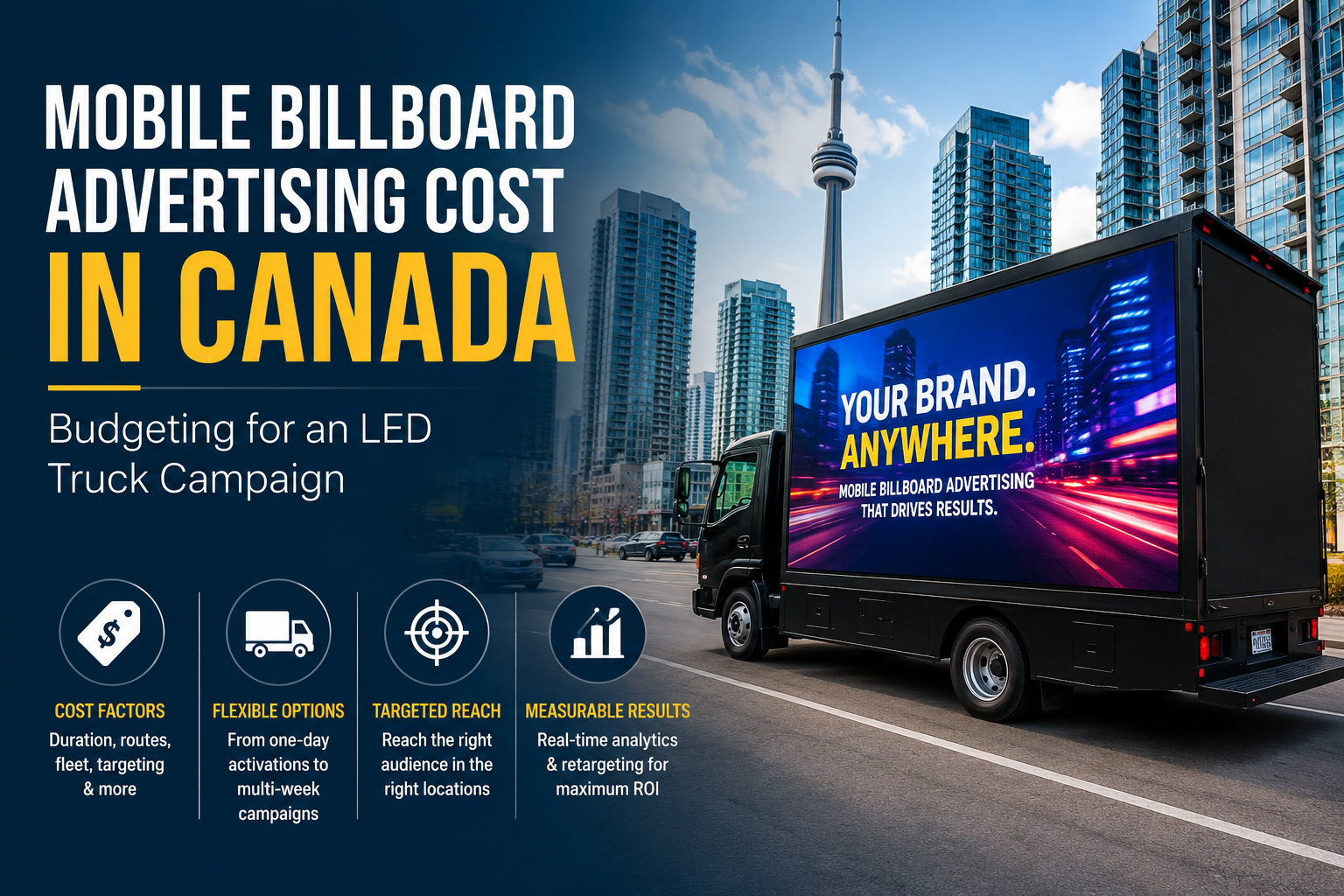
Mobile billboards are likely part of the proposal for your Out-Of-Home (OOH) advertising client. It is easy to understand why: LED billboard trucks provide high visibility and appealing data analytics to the client, street-level exposure, and metrics that a static advertisement cannot provide. However, before you add this to a media plan, it is vital to understand the mobile billboard advertising cost Canada campaigns require.
Pricing for mobile billboard advertising in Canada is heavily influenced by duration, availability of the fleet, geographic targeting, and advertisement provider capabilities. For example, a single-item charge for a media budget might be a single-truck, single-day activation versus a multi-city, multi-week campaign with digital analytics and targeting, as well as retargeting, incorporated into the service.
This guide helps advertising agency media planners and account staff understand the overall mobile billboard advertising cost Canada landscape, the factors that affect those rates, and the best way to run a campaign that provides clients with a positive, measurable return. It also addresses the difference between a higher level of service versus the basics of a standard truck rental. In this advertising format, those differences are very important.
What Is Mobile Billboard Advertising and Why Do Agencies Use It?
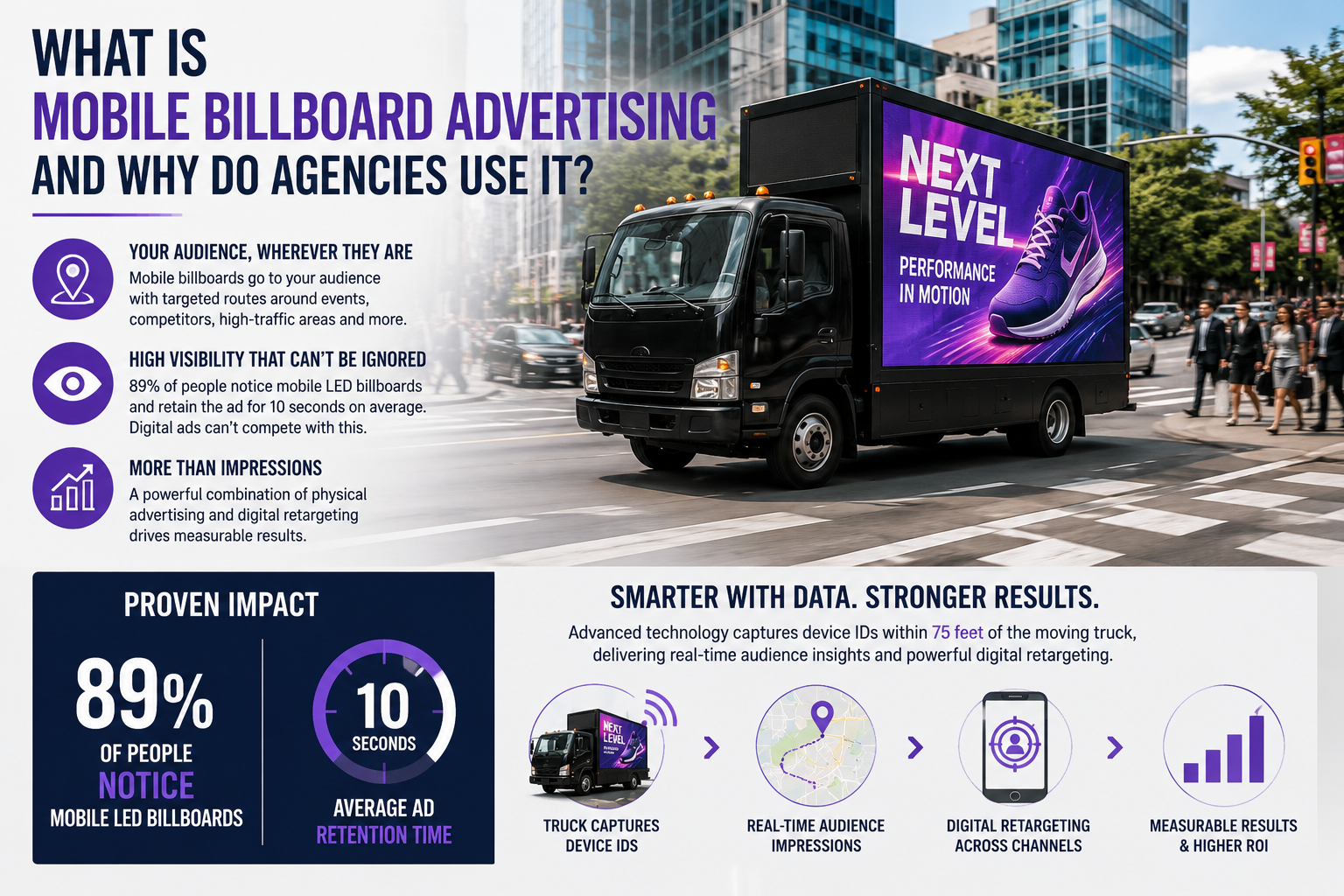
Let’s skip the hype and get straight to the details. Mobile billboard advertising displays high-brightness LED screens on trucks that drive customized routes through targeted areas. These areas could be around your event venue, near competitors, through high-traffic corridors, or wherever your target audience is located.
Mobile billboards go to your audience, whereas static billboards do not. Mobile billboards also go to areas where digital ads cannot be blocked, skipped, or scrolled past. Studies show that 89% of people notice mobile LED billboards, and ordinary people retain the ad for 10 seconds. Digital formats cannot compete with this.
2026 will see even more of a draw for agencies. Enhanced providers, like Media Trucks, have proprietary technology that captures device IDs to within 75 feet of the moving trucks. This tech allows for real-time audience impressions and, most importantly, offers the ability to digitally retarget the audience when the trucks are no longer on the street. For clients who need more than impressions to show results, the combination of physical advertising and digital advertising makes mobile billboard advertising incredibly attractive.
What Factors Impact Billboard Truck Campaign Pricing?
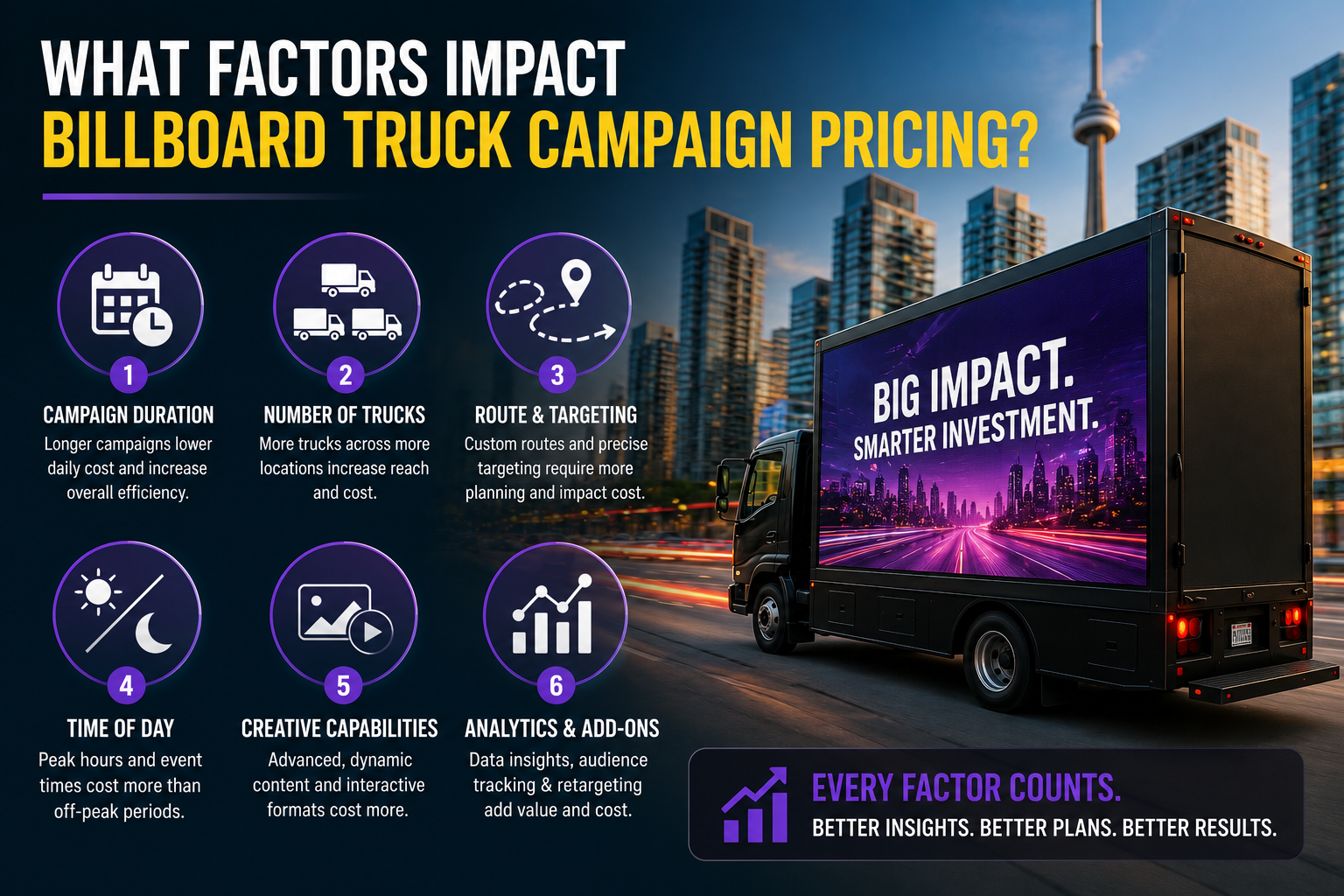
There is no such thing as a flat rate for an LED truck campaign. Several factors impact billboard truck campaign pricing in Canada, and understanding these elements will allow you to build a much more accurate client proposal.
1. Campaign Duration
2. Number of Trucks in the Fleet
3. Route Complexity and Targeting
4. Time of Day and Dayparting
5. Creative Capabilities
6. Analytics and Retargeting Add-Ons
Mobile Billboard Advertising Cost Ranges in Canada
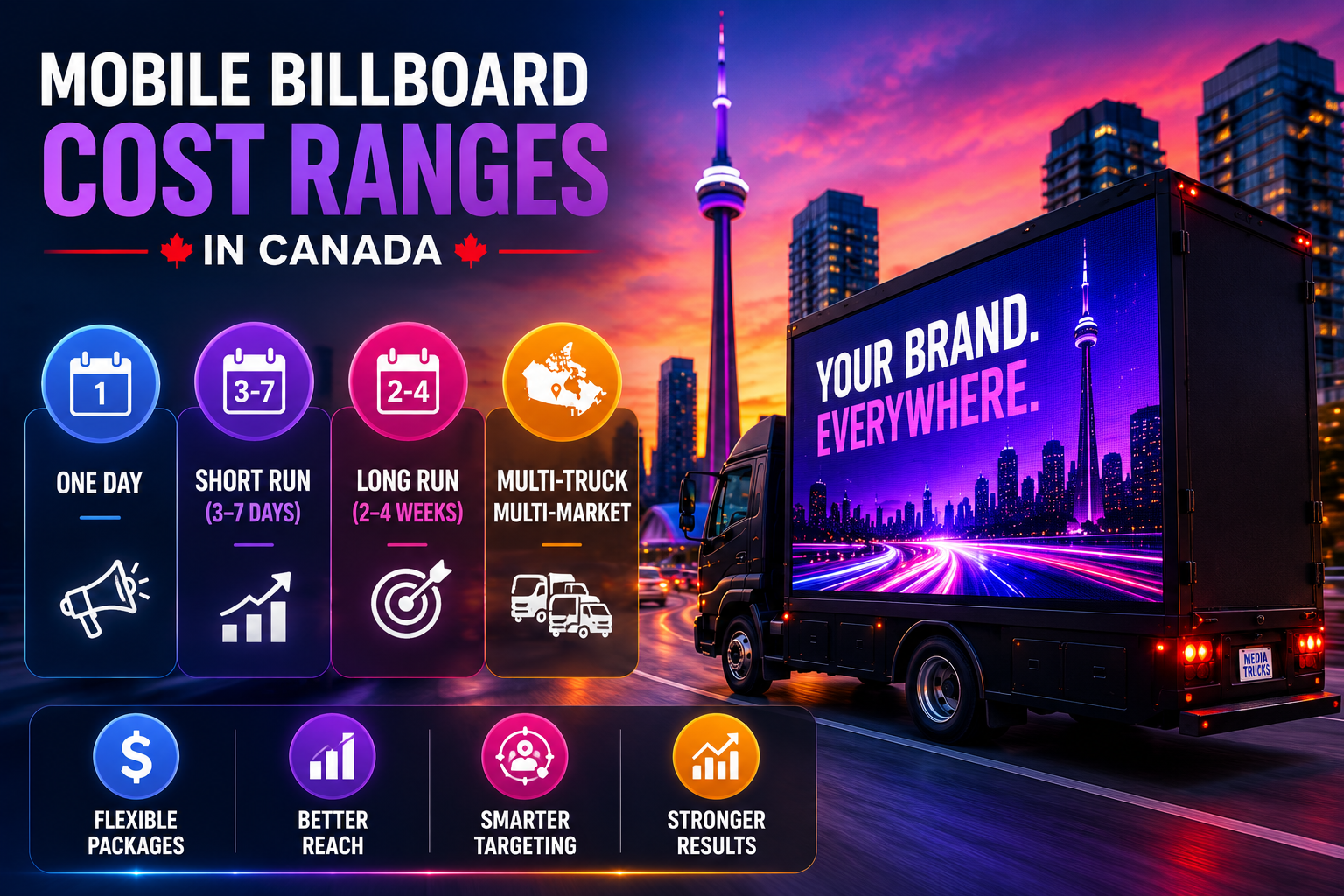
If you are evaluating how much a mobile billboard costs for a Canadian advertising agency, here is a rough operational breakdown of how campaigns are typically structured:
- One Day Activations: Easily the most accessible option for clients wanting something bigger than a standard billboard, and often used to generate focused marketing impact on a single day, such as a product launch or special event.
- Short Run Campaigns (3 to 7 Days): Once a campaign launches, the route can be adjusted based on day-to-day performance. This timeline is perfect for seasonal marketing pushes or retail promotions to get the most exposure.
- Long Run Campaigns (2 to 4 Weeks): The daily cost of this campaign type works out to less than shorter runs, and clients get a significant improvement in overall campaign reach. This is especially effective for industries like retail, auto, real estate, and mobile apps where repeated exposure improves brand perception and increases conversion rates.
Multi-Truck, Multi-Market Campaigns
For national clients or major event budgets, the premium tier involves deploying several trucks in multiple markets, including Toronto, Ottawa, Hamilton, Mississauga, and more. Coverage can be arranged through Media Trucks, one of the only providers operating Canada’s largest LED (light-emitting diodes) truck fleet to service all Ontario and national needs.
As the majority of campaign pricing is custom to each booking, the best way to budget is to inquire directly with a provider to see exactly how much a mobile billboard costs for your specific target region. For Media Trucks, you can accomplish this by visiting their Get a Quote page and filling out the form with your campaign needs to receive a detailed proposal within 24 hours.
LED Truck Rental Toronto: What Agencies Need to Know
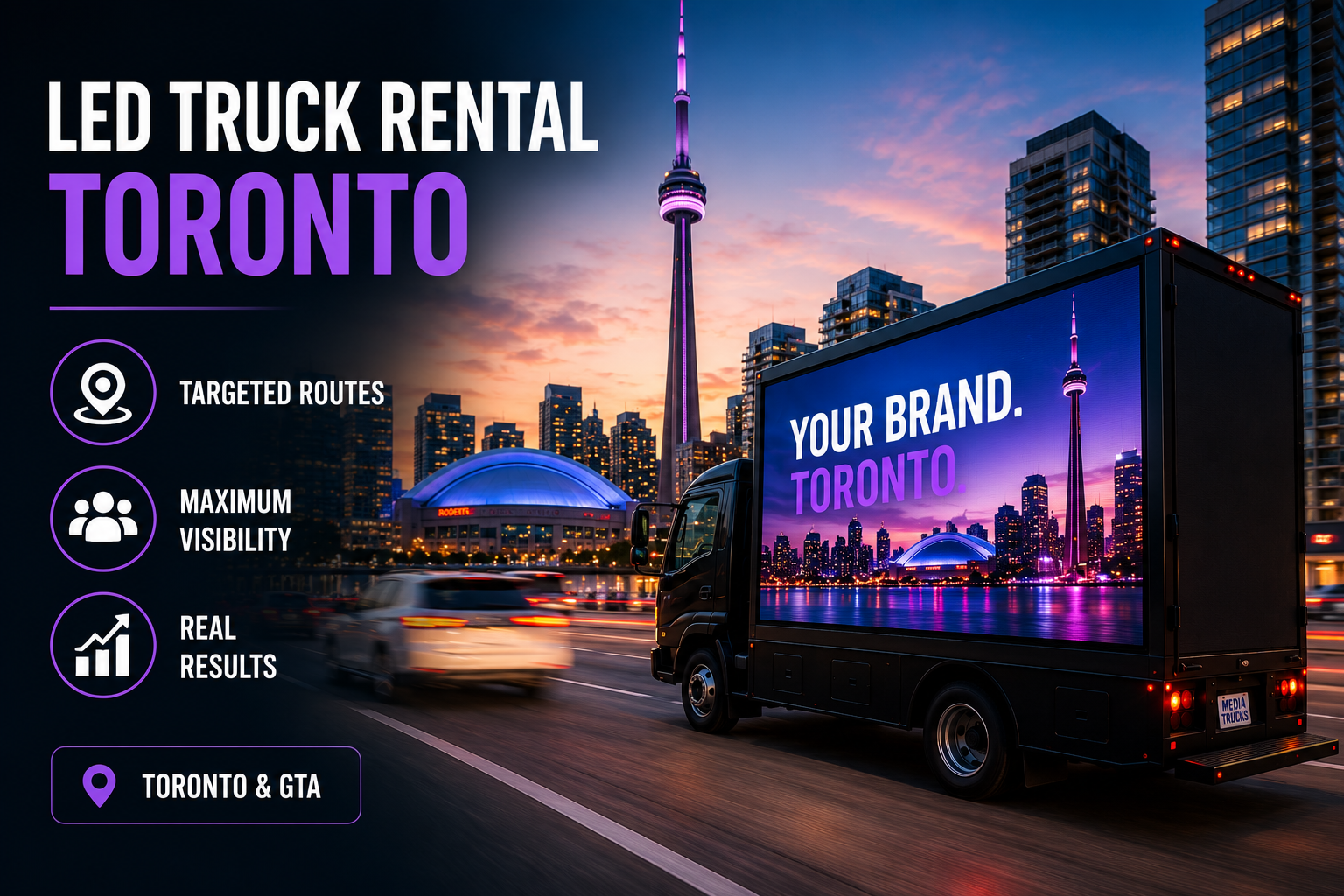
Toronto is the primary market for most agency campaigns using mobile billboards in Canada. The market is ideal for this advertising format considering the Greater Toronto Area’s density, high-volume traffic, multiple event venues, dense corporate offices, and extensive retail hubs.
In Toronto, agencies looking for an LED truck rental Toronto solution can choose between basic standard billboard trucks and highly sophisticated, data-driven options. Media Trucks owns and operates Canada’s largest fleet, including their 360° Bezelless LED truck, which exclusively supports high-impact advertising formats that require a premium presentation beyond the capacity of basic rental units.
When agencies assess solutions, they recognize the value of more than just a truck with a screen. They consider all aspects of the partnership, from route planning to device ID tracking, digital retargeting, and final campaign reports. Brand-level and enterprise-level clients expect more than the baseline equivalent of a simple LED truck rental Toronto vehicle; they expect measurable campaign performance.
Media Trucks has operated in Toronto and the GTA since 2015, logging over 68,000 hours of campaign work. As an example of the quality their campaigns deliver, a two-day Toronto real estate campaign generated 31 showings and sold the property for $100,000 above the asking price. On one event night, a single-day campaign in front of the Scotiabank Arena drove 9,400+ downloads via device ID and digital retargeting. These outcomes are the results of recorded campaigns and not vague estimates.
You can visit their official Mobile Billboard service page to discover more about their specialized capabilities. You can also check out how they stack up against the competition by reviewing other top LED Mobile Billboard Companies in the Canadian market.
How to Justify Mobile Billboard Cost to a Client
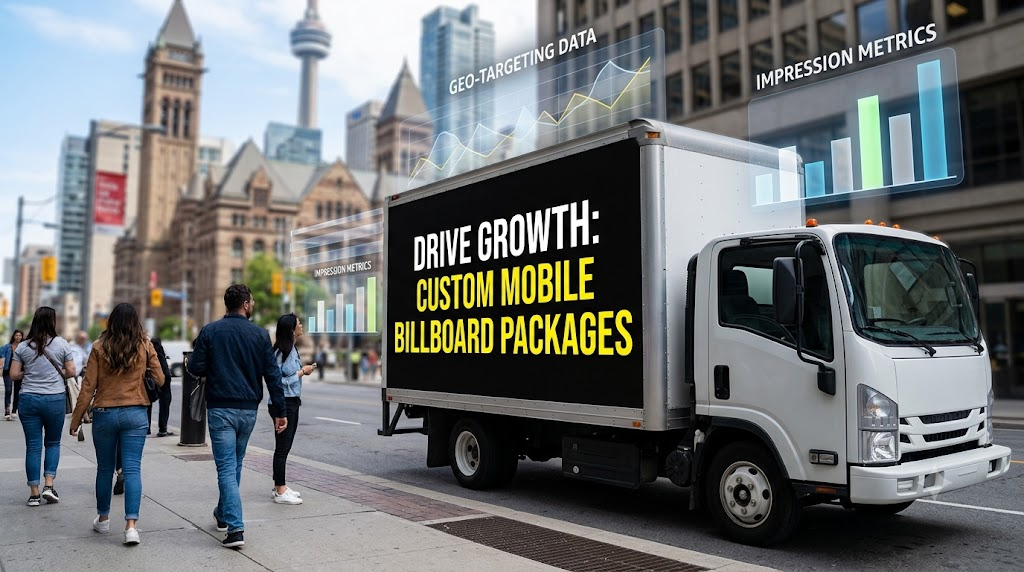
For clients who are new to this type of advertising, the focus of the discussion typically revolves around cost per thousand impressions (CPM) and how the campaign can be verified.
Mobile billboard ads can have some of the lowest CPMs when it comes to experiential and out-of-home advertising. When factoring in the quality of attention, where audiences focus on the mobile billboard for an average of 10 seconds as compared to the millisecond attention seen with traditional digital billboards, the value of an impression is even stronger.
When looking at provability, the analytics layer is your strongest asset. Out-of-home (OOH) advertising has historically been critiqued for inaccurate estimated reach. However, with modern tracking tools, ads can be targeted to OOH audiences within 75 feet of the trucks with actual dwell time and demographic data. This enables precision digital retargeting, which helps secure contract renewals from satisfied clients.
Billboard Truck Campaign Pricing: The Right Package for Your Client
The campaign’s objective should help guide your mobile billboard package formulation. For example, a brand awareness campaign would be packaged far differently than a highly focused event activation or a campaign centered on driving business away from direct competitors. It also helps dictate the optimal route, the campaign’s core strategy, and how long the campaign will run before final costs are calculated.
Alongside the campaign’s objectives, the audience should be strategically mapped out across key geographies. Professional fleets are available in Toronto, North York, Markham, Mississauga, Brampton, Oakville, Ottawa, Hamilton, Vaughan, Kitchener, Windsor, London, and beyond. For campaigns planned across several cities, identifying the target areas early on can help direct fleet and budget planning.
Consider analytics from day one. Device ID capture and retargeting should be built into the billboard truck campaign pricing structures from the very start. The data collected while the campaign is live has additional use for remarketing long after the trucks leave the street, investing pay off over the long term.
Schedule the creative alongside the campaign layout. The most successful LED truck campaigns use creative assets explicitly designed for street-level viewing. This includes large, bold visuals and concise messaging that can be read easily while the vehicles are in motion. If 3D content is required, this must be factored into the creative brief and production timeline early in the process.
Final Thoughts: What to Budget and Where to Start
In Canada, mobile billboard advertising provides a clear, competitive edge over traditional static media. Mobile billboards have proven to be a highly measurable advertising system to track real-world exposure, analyze reach, and continue the conversation digitally long after the campaign has finished on the streets.
To establish your budget plan, first identify what you want to achieve and where your target market is located. From there, partner with a dedicated provider who can construct a custom proposal aligned with your exact goals. For over 10 years, Media Trucks has invested in building Canada’s largest LED fleet alongside proprietary analytics technology to verify campaign results. They are fully equipped to support agencies of all sizes, with services spanning single-day targeted activations to comprehensive campaigns distributed across multiple Canadian markets.
To get started on your upcoming campaign structure, you can head directly to the Get a Quote page to see how your custom plan can take shape within 24 hours.
Frequently Asked Questions
The absolute mobile billboard advertising cost Canada teams experience is highly dependent on the duration of the campaign, the number of trucks in the fleet, the target market, and the analytics packages offered. One-day mobile advertising campaigns are the lowest entry point, while multi-day, multi-truck campaigns across multiple markets represent a larger investment. A custom, optimized quote can be obtained directly based on your specific route needs.
Traditional truck billboards rely on static printed vinyl panels, whereas LED trucks use dynamic digital displays. These screens can showcase video, animation, and even 3D content. Because the creative assets can be updated remotely while the trucks are on the move, LED campaigns generate significantly higher engagement. The inclusion of real-time audience data tracking also makes them a much better choice for modern advertising agencies.
Yes, mobile billboards are highly effective for brands with immediate, high-impact short-term goals. For example, a single-day campaign parked near the Scotiabank Arena recorded over 9,400 app downloads, while a two-day real estate push brought in 31 physical showings and helped sell a property for $100,000 over the asking price. Few advertising formats can compete with this exact combination of high outdoor exposure and digital retargeting capabilities.
The timeline can be as short as a couple of weeks if it is a straightforward, single-city campaign. However, if it is a complex campaign that requires multiple advertising trucks to be spread across several Canadian cities, it is highly recommended to provide advanced notice to secure fleet availability and optimal route preferences.
Absolutely. Modern mobile billboards feature digital ID capture systems that integrate seamlessly with programmatic digital advertising systems. This offers a smooth, multi-channel transition from physical outdoor advertising to direct online remarketing.