Using a mobile LED advertising truck within the Greater Toronto Area (GTA) is one of the effective ways to get advertising. But dealing with local advertising by laws like laws governing provincial highways, and laws governing broadcast advertising can be daunting.
Before starting your outdoor media campaign, understanding the local compliance safeguards your investment and allows advertising without interruptions. Listed below are mobile billboard advertising regulations, permits, and display laws for the City of Toronto and surrounding areas.
Is Mobile Billboard Advertising legal in Toronto?
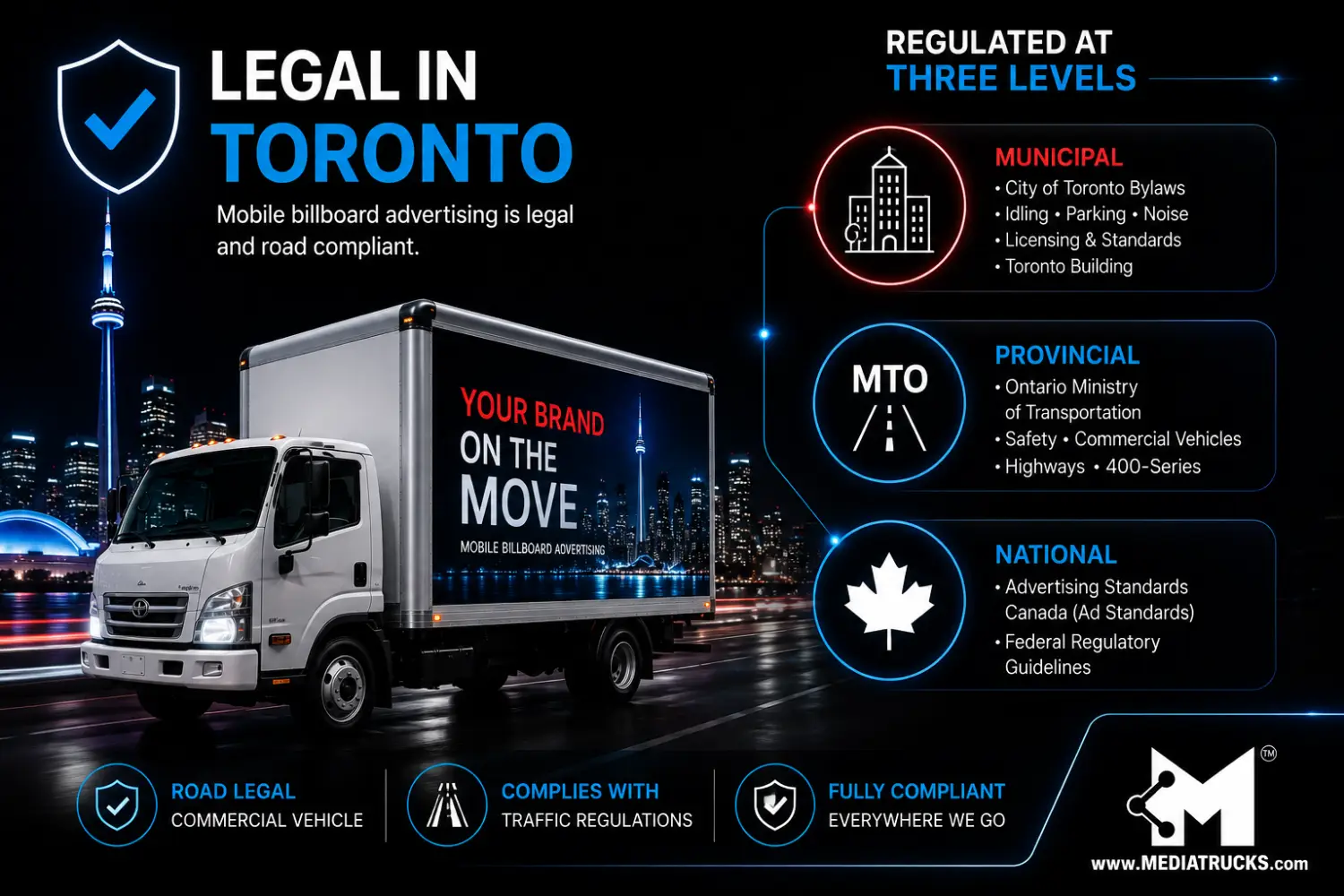
Mobile billboard advertising is legal in Toronto. Commercial vehicles are allowed to display digital or static messaging and can be driven along public roadways as long as the vehicle adheres to the Ontario Highway Traffic Act and applicable Municipal Traffic regulations.
Fixed roadside billboards are tightly regulated by city bylaws (like Toronto’s Chapter 694), while mobile billboards are simply commercial vehicles on the road displaying ads.
Who Regulates Mobile Billboard Advertising in Ontario?
Mobile advertising billboards are governed by Municipal, Provincial, and National laws.
- At the Municipal Level: Idling, Parking, and Noise bylaws of the City of Toronto, Municipal Licensing & Standards, and Toronto Building.
- At the Provincial Level: Ontario Ministry of Transportation (MTO) governs safety and commercial vehicles, highway transit, and the corridors of the Provincial 400-series highways.
- At the National Level: Advertising Standards Canada (Ad Standards) and other federal regulatory bodies.
Do You Need a Permit for Mobile Billboard Advertising in Toronto?
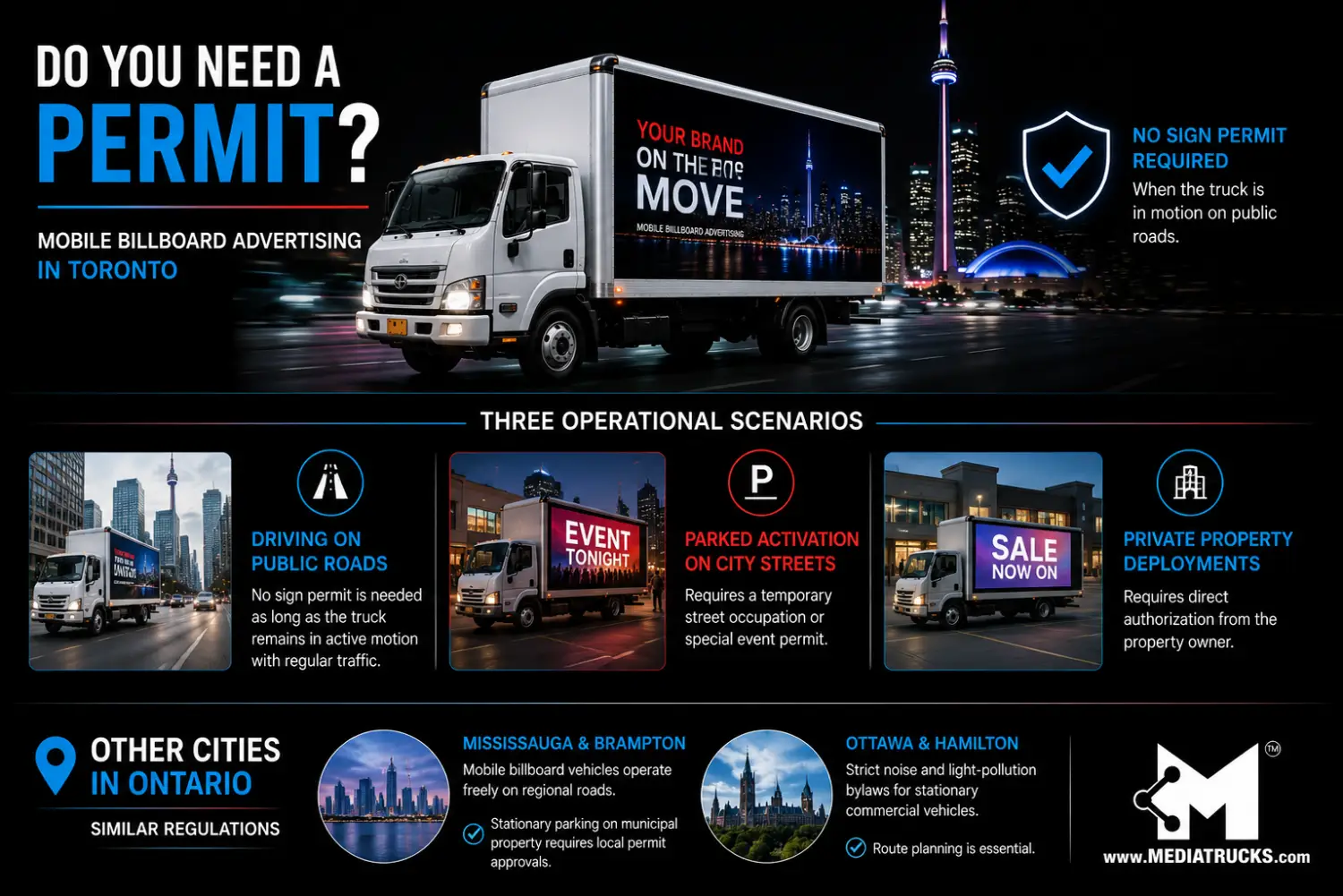
For standard mobile campaigns where an LED truck drives along active transit routes, you do not need a stationary municipal sign permit. Because the screens are integrated into a licensed commercial motor vehicle, the display is classified as vehicle graphics rather than a fixed third-party sign structure.
However, specific operational scenarios do require temporary permits or operational authorization.
Permit Requirements for LED Truck Advertising in Toronto
If you are looking to secure an LED truck advertising permit Canada or operate within Toronto city limits, keep these three operational scenarios in mind:
- Driving on Public Roads: No sign permit is needed as long as the truck remains in active motion with regular traffic.
- Parked Activation on City Streets: Parking an LED truck in a public street metering bay or loading zone to run a stationary activation requires a temporary street occupation or special event permit.
- Private Property Deployments: Parking on private commercial property, such as mall parking lots or private event venues, requires direct authorization from the property owner rather than a city sign permit.
What About Other Cities in Ontario? (GTA, Ottawa, Hamilton)
- Mississauga & Brampton: Mobile billboard vehicles operate freely on regional roads. Stationary parking on municipal property requires local permit approvals.
- Ottawa & Hamilton: Both cities enforce strict noise and light-pollution bylaws for stationary commercial vehicles, making route planning essential.
To see how geographic routing factors into campaign success across these regions, check out our guide on How to Plan a Mobile Billboard Route in Toronto.
Restricted Zones and No-Go Areas for Mobile Billboards in Toronto
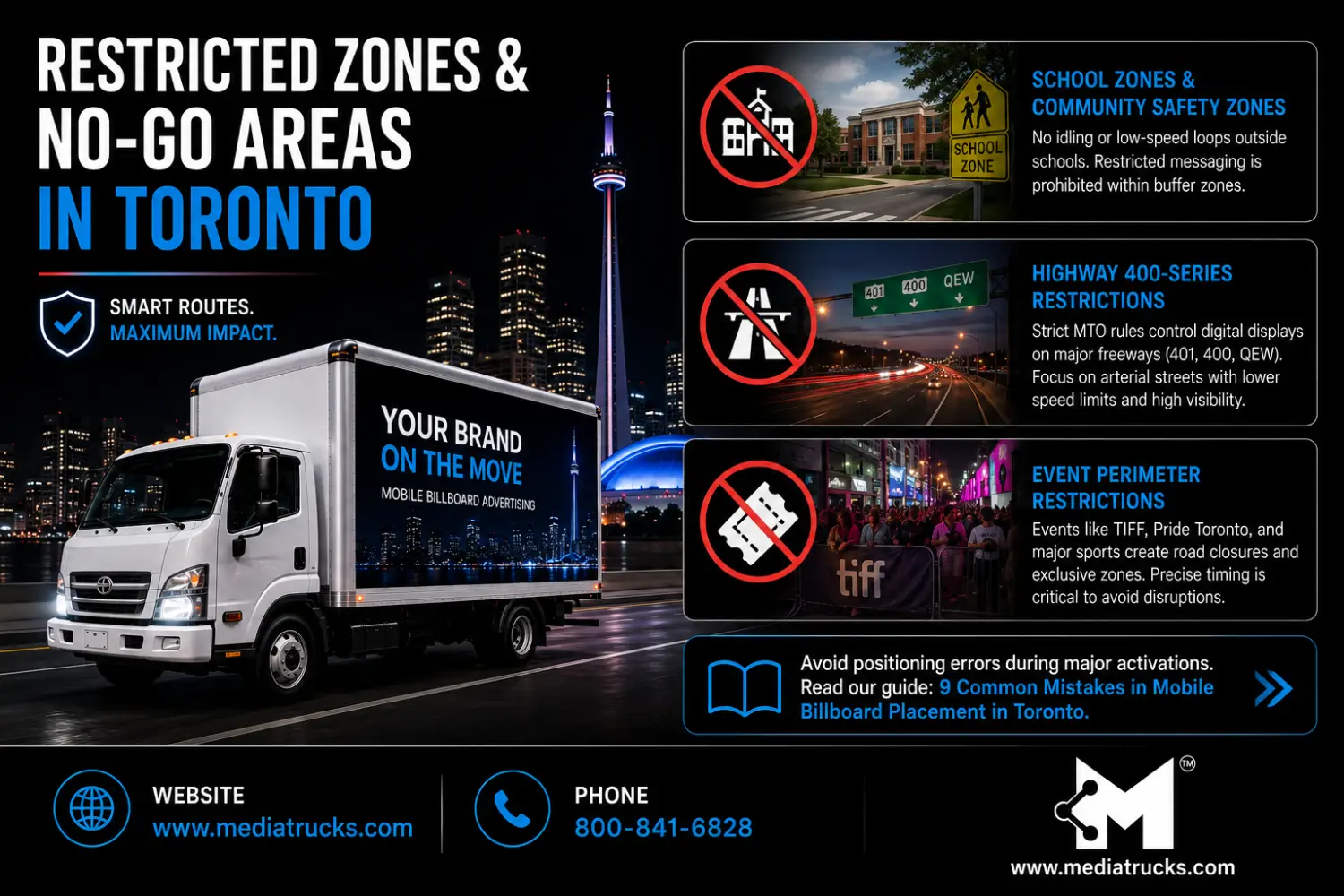
While mobile billboards offer remarkable reach, certain locations have strict operational limits.
School Zones and Community Safety Zones
Driver safety and child protection guidelines restrict heavy commercial vehicles from idling or running continuous low-speed loops directly outside elementary and secondary schools. Restricted product messaging, such as age-gated goods, is strictly prohibited within buffer zones surrounding school grounds.
Highway 400-Series Restrictions
Ontario’s Ministry of Transportation (MTO) maintains strict rules regarding digital displays along major provincial freeways like Highway 401, Highway 400, and the QEW. High-brightness digital motion that could distract high-speed traffic is controlled. Most mobile campaigns focus on high-density arterial surface streets like Yonge Street, Bloor Street, or University Avenue where speed limits are lower and pedestrian visibility is high.
Event Perimeter Restrictions (e.g., TIFF, Festivals)
Major events like the Toronto International Film Festival (TIFF), Pride Toronto, or major sporting events often establish temporary road closures and exclusive marketing zones. Running a campaign near these perimeters requires precise timing to avoid traffic blockades or municipal event marshals.
To avoid positioning errors during major activations, read our breakdown on 9 Common Mistakes in Mobile Billboard Placement in Toronto.
Content Regulations: What Can and Cannot Be Displayed
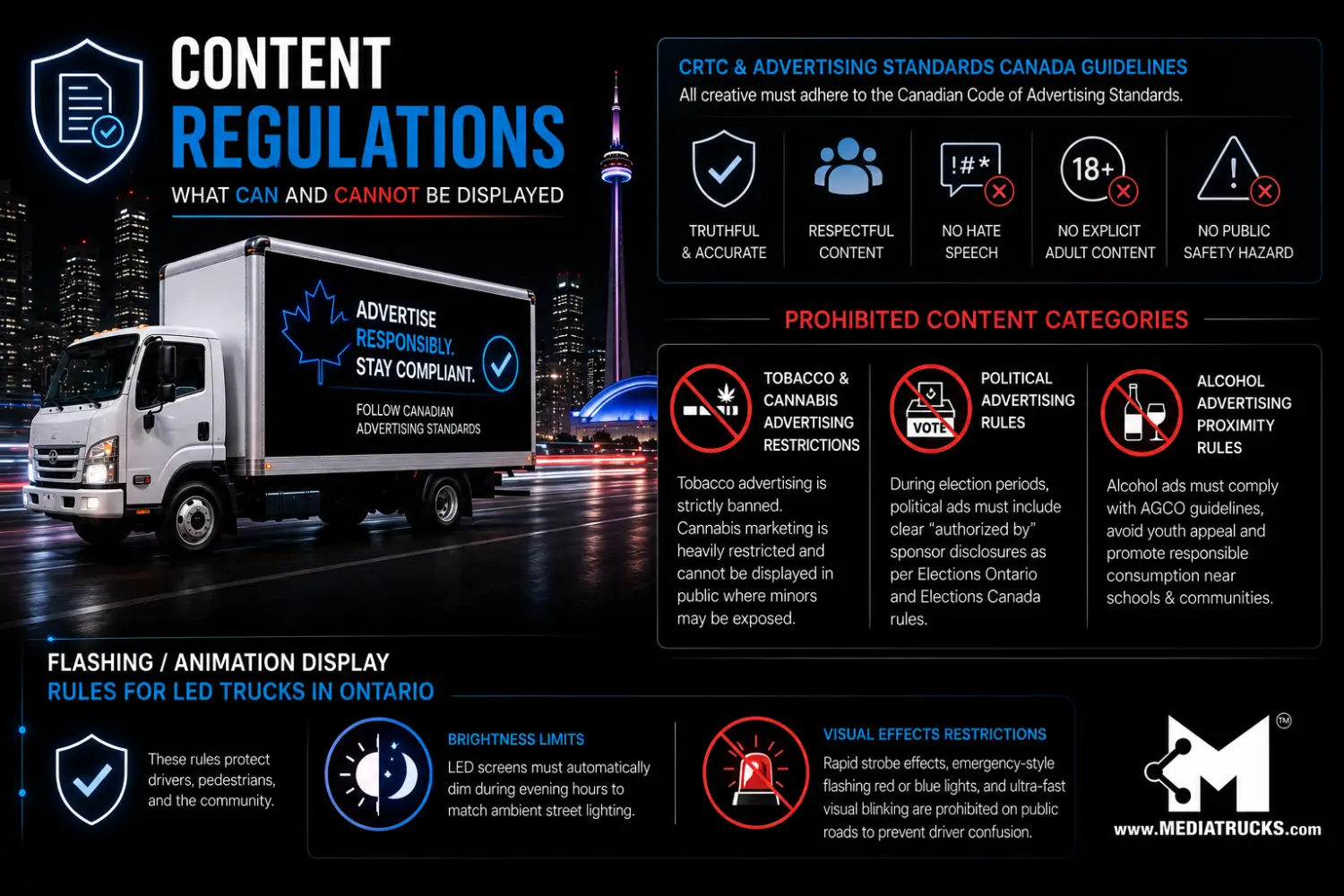
The creative content displayed on an LED billboard truck must comply with Canadian advertising laws and industry codes. Adhering to these DOOH advertising rules Ontario ensures your creative runs smoothly without administrative halts.
CRTC and Advertising Standards Canada Guidelines
All creative must adhere to the Canadian Code of Advertising Standards. Advertisements cannot contain misleading claims, hate speech, explicit adult content, or material that creates a public safety hazard.
Prohibited Content Categories
- Tobacco and Cannabis Advertising Restrictions: Federal regulations strictly ban out-of-home advertising for tobacco products. Cannabis marketing is heavily restricted and cannot be displayed in public spaces where minors may be exposed.
- Political Advertising Rules During Election Periods: During municipal, provincial, or federal election periods, political ads must display clear “authorized by” sponsor disclosures in accordance with Elections Ontario and Elections Canada rules.
- Alcohol Advertising Proximity Rules: Alcohol creative must comply with AGCO (Alcohol and Gaming Commission of Ontario) guidelines, avoiding youth appeal or encouraging irresponsible consumption near schools and community spaces.
Flashing/Animation Display Rules for LED Trucks in Ontario
To preserve driver safety and avoid visual distractions, municipal transit authorities and road safety standards regulate how light and animation are presented:
- Brightness Limits: LED screens must automatically dim during evening hours to match ambient street lighting.
- Visual Effects: Rapid strobe effects, emergency-style flashing red or blue lights, and ultra-fast visual blinking are prohibited on public roads to prevent driver confusion.
How Media Trucks Ensures Full Compliance on Every Campaign
Navigating regulatory requirements should not be your burden. At Media Trucks, we maintain complete outdoor advertising compliance Toronto standards for every deployment:
- MTO-Compliant Fleet: All vehicles undergo regular commercial safety inspections and carry full commercial insurance.
- Route Pre-Screening: We map out compliant routes that avoid restricted zones, low-clearance bridges, and unauthorized road corridors.
- Creative Vetting: Our team reviews all artwork to ensure adherence to Ad Standards, AGCO rules, and brightness guidelines before broadcast.
- Permit Management: If your campaign requires a stationary parking permit or private property clearance, we manage the application process directly.
If you are evaluating out-of-home formats, explore our comparative analysis on Mobile Billboard vs Static Billboard Advertising in the GTA or learn about options for smaller budgets in Mobile Billboard Advertising for Small Businesses Toronto.
Ready to Launch a Fully Compliant Mobile Billboard Campaign in Toronto?
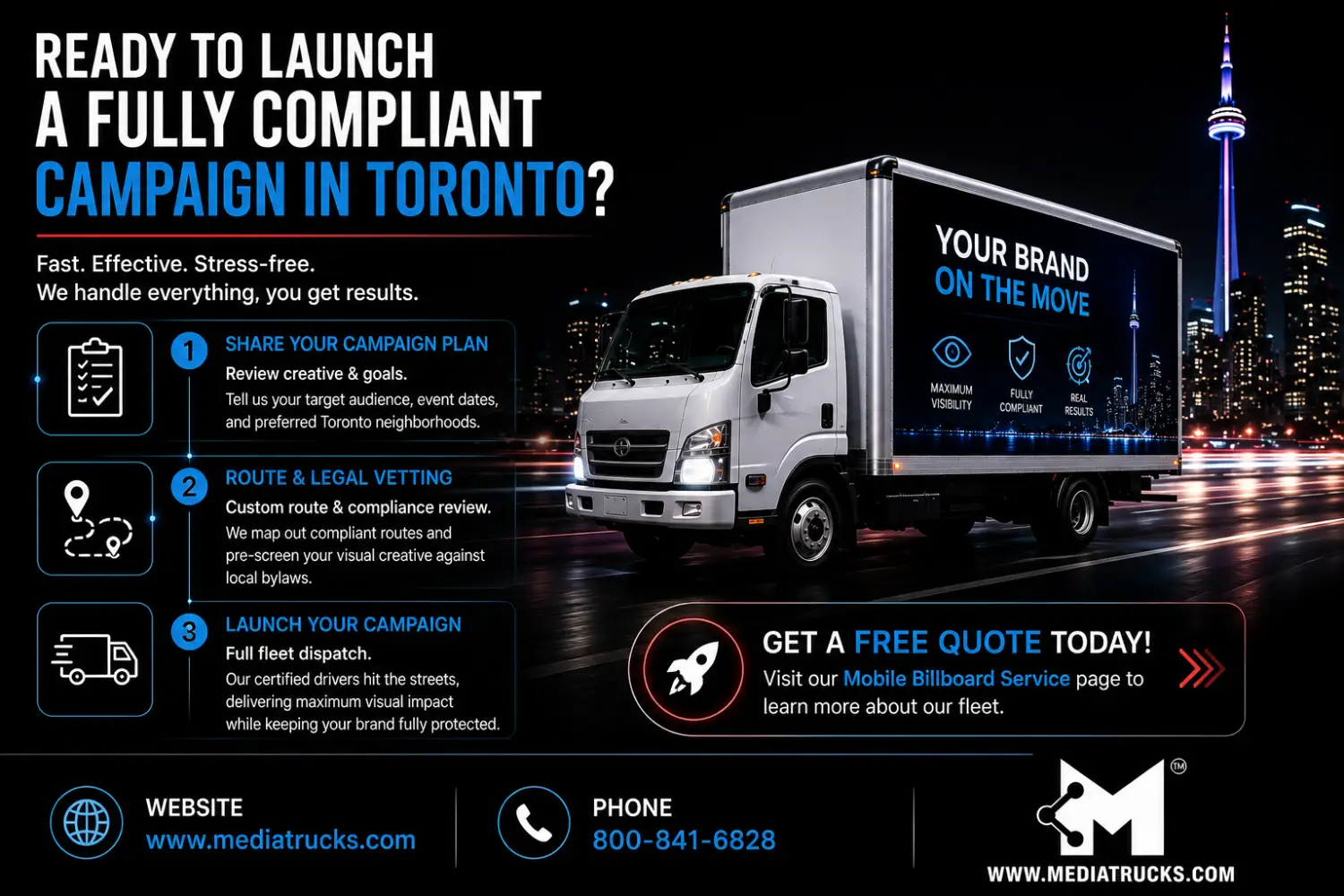
Getting your message on the road is fast, effective, and completely stress-free when you work with experienced outdoor advertising professionals.
1.Step 1: Share Your Campaign Plan:Review creative & goals.
Tell us your target audience, event dates, and preferred Toronto neighborhoods.
2.Step 2: Route & Legal Vetting:Custom route & compliance review.
We map out compliant routes and pre-screen your visual creative against local bylaws.
3.Step 3: Launch Your Campaign:Full fleet dispatch.
Our certified drivers hit the streets, delivering maximum visual impact while keeping your brand fully protected.
Visit our Mobile Billboard Service page to learn more about our fleet, or connect with our team today to Get a Free Quote.
Frequently Asked Questions: Mobile Billboard Regulations Toronto
No, as long as your campaign operates within normal road regulations and uses a professional operator who follows municipal idling, noise, and traffic rules.
External audio is permitted in certain commercial zones during daytime hours, but must comply with local municipal noise bylaws. Audio is typically disabled in residential zones or late at night.
No special permit is required for the vehicle itself, but political ads must comply with election financing laws and display approved sponsor identification tags.
Trucks can park in legal metered parking spaces for short periods, provided they follow standard parking time limits. Extended stationary displays or street takeovers require temporary street use permits.